
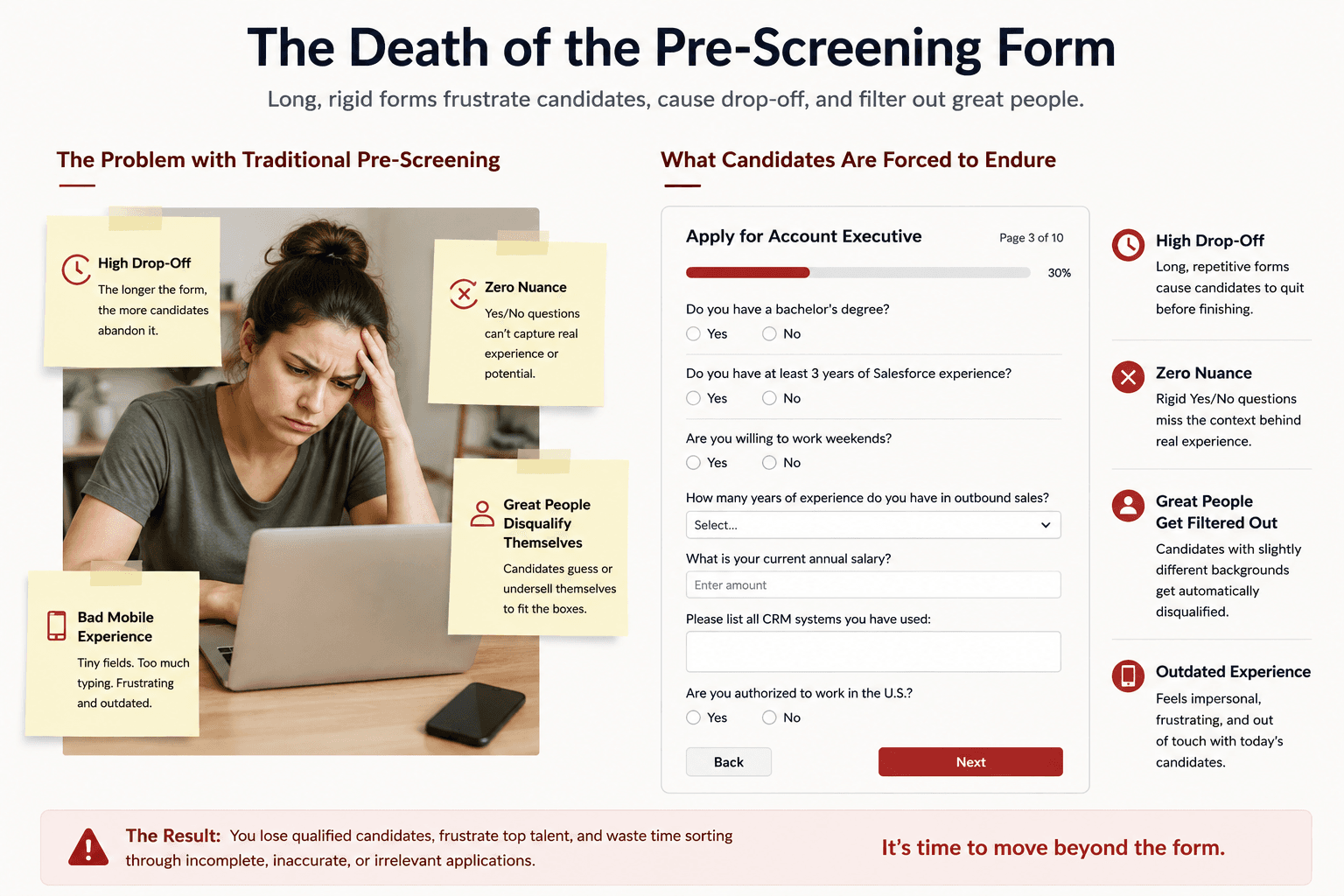
If there is one universal truth in digital recruiting, it's this: the longer your application form, the higher your drop-off rate. In a desperate attempt to filter unqualified applicants before they reach a human recruiter, companies have spent the last decade bolting multi-page questionnaires onto the front of their ATS.
"Do you have a bachelor's degree? Do you have at least 3 years of Salesforce experience? Are you willing to work weekends?"
These static pre-screening forms are remarkably fragile. They're rigid, annoying to complete on a mobile device, and they provide zero nuance. A candidate with two years and nine months of intensive Salesforce experience might click "No" and automatically disqualify themselves — when a human recruiter would have gladly moved them forward.
The integration of conversational AI marks the end of the static pre-screening era.
Replacing a questionnaire with a dynamic video interview transforms how top-of-funnel data is collected. Instead of forcing an applicant through ten pages of dropdowns, a company can request a name and phone number, then immediately invite the candidate to a conversational AI video assessment via SMS.
When the AI assistant engages the candidate, it seamlessly collects all the necessary qualifying information through natural dialogue.
"The core requirement for this role is deep familiarity with Salesforce architecture. Can you tell me about the most complex implementation you've managed?"
If the candidate responds that they primarily use HubSpot but have light Salesforce familiarity, a static form would have already disqualified them. An adaptive AI keeps the thread alive: "We occasionally evaluate candidates with strong HubSpot backgrounds if they have deep API integration experience. Have you handled complex API routing within HubSpot?"
This dynamic probing replaces rigid exclusionary forms with an intelligent assessment layer that can capture far more nuance without fatiguing the candidate. Candidates also strongly prefer interacting with a responsive voice assistant over typing long paragraph answers on a mobile keyboard.
The data collected is also immediately structured. Hiring managers don't read through messy form responses — they view the AI-generated semantic scorecard highlighting the exact competencies demonstrated during the conversation, automatically injected into the ATS profile.
To see how a dynamic voice assistant can replace a multi-page form for your hardest-to-fill role, book a demo with the Braintrust AIR team.