
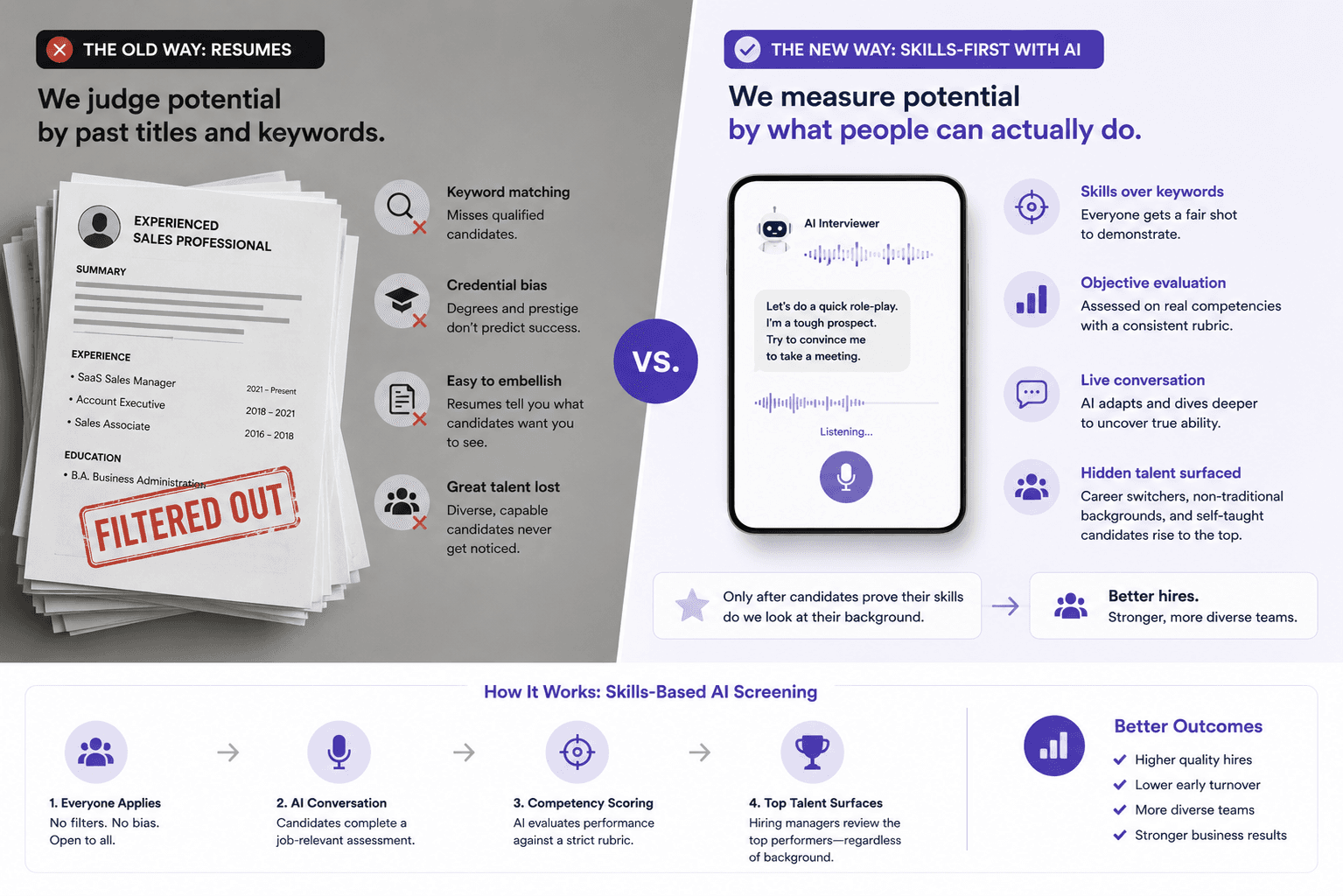
The resume is fundamentally broken. Since the 1950s, the primary mechanism for deciding whether a person can perform a job is a heavily embellished, keyword-stuffed piece of paper listing historical job titles. Empirical research has repeatedly demonstrated that educational pedigree and previous employer prestige are weak predictors of future performance.
Despite this, legacy Applicant Tracking Systems and human recruiters continue using resumes as the primary top-of-funnel filter, systematically discarding brilliant candidates simply because they lack the "right" keywords. The shift toward skills-based hiring — evaluating candidates on actual competencies rather than credentials — has been a noble goal, but difficult to execute at scale. Until now.
The aggressive adoption of conversational AI interview tools is the technological catalyst finally making skills-based hiring a reality.
When an organization deploys AI voice screening, they can effectively skip the resume. Instead of using a parsed document to guess if an applicant has problem-solving skills, they invite every applicant to simply demonstrate those skills.
Imagine an enterprise hiring a fleet of B2B sales development representatives. A traditional process filters out anyone without a college degree or direct SaaS sales experience. With an AI screening tool, the company opens the top of the funnel entirely. Everyone who applies receives a 10-minute conversational assessment.
The AI engages the candidate in a mock cold call. It evaluates their objection handling, resilience, vocal tonality, and ability to steer a conversation toward a scheduled meeting. When scoring is complete, the hiring manager reviews the top 5% of candidates ranked purely on their demonstrated ability to sell.
Only after a candidate proves their competence does the hiring manager look at their background. They frequently discover that the best-performing candidates on the assessment are people transitioning from entirely different industries — retail managers, hospitality workers, military veterans — who possess raw communication skills but whose resumes would have been instantly filtered out by a legacy system.
This approach democratizes opportunity. By assessing all candidates against strict behavioral and technical competencies, platforms like Braintrust AIR organically surface more diverse, capable slates of candidates. Hidden talent is no longer hidden behind bad resumes — it's actively surfaced through dynamic dialogue.
Skills-based AI assessments also reduce early employee turnover significantly. Candidates hired via competency models are better aligned with the actual requirements of the role, leading to higher job satisfaction and better performance outcomes.
To understand how a competency-based AI rubric differs from legacy parsing, book a demo and let us design a pure skills-assessment flow for your hardest-to-fill role.