An AI interviewer is software that conducts a structured job interview with a candidate — usually by voice, chat, or video — scores each answer against role-specific rubric criteria, and returns a transcript, scores, and rationale for a human recruiter to review. It is built to replace or augment the early screening conversation when volume outruns recruiter capacity. It should not silently hire or reject anyone.
That definition is the buyer question. The rest of this page is how evaluation actually works: rubrics, scoring separation, human-in-the-loop design, fairness constraints, and the evidence that exists today. For the broader category map (conversational voice vs one-way video vs skills tests), start with what AI interview software is.
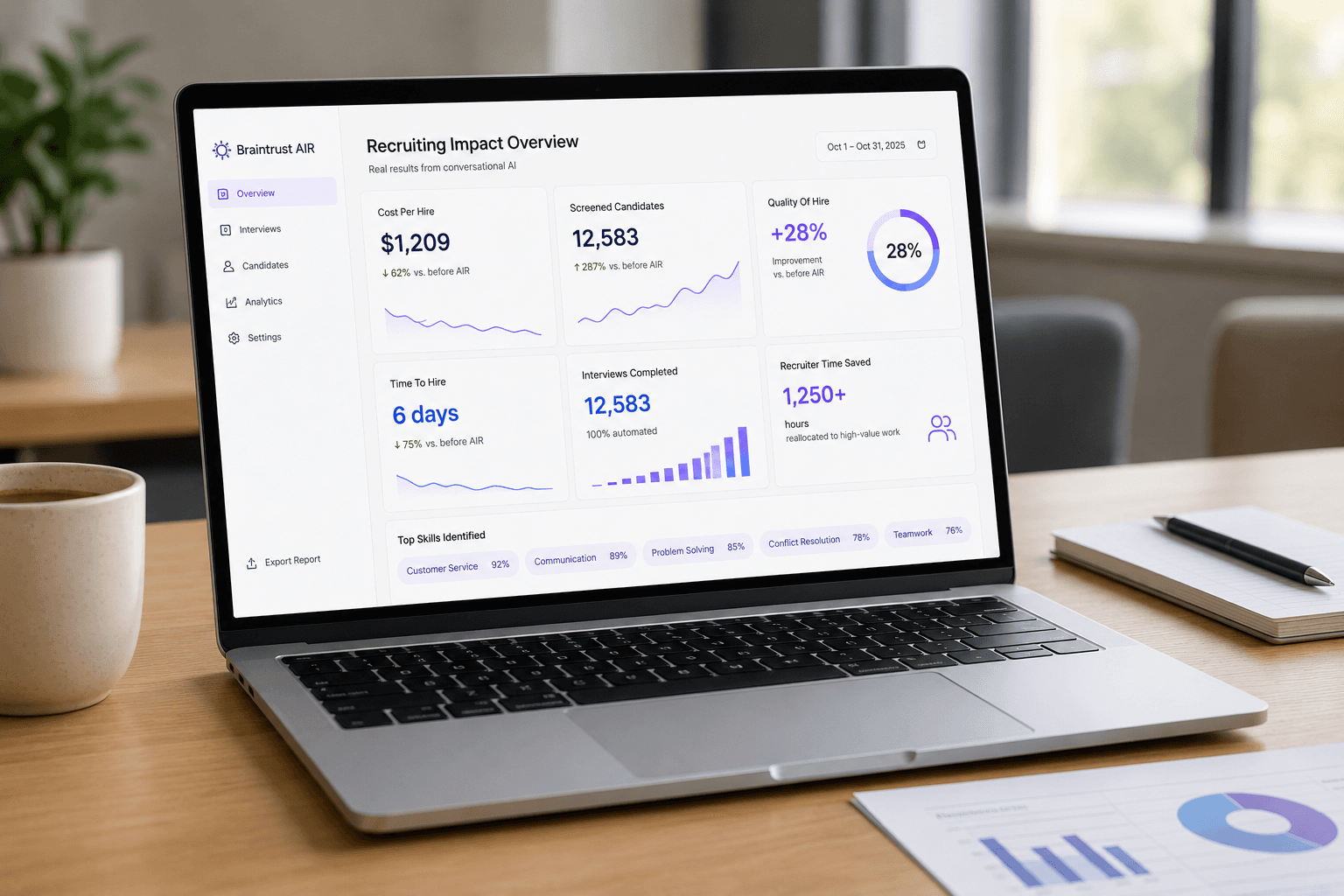
Braintrust AIR is a conversational AI interviewer for enterprise screening: live adaptive voice interviews, rubric scores, and an ATS-synced ranked evidence pack. Humans decide who advances. AIR does not auto-reject. Teams can try AIR or book a demo.
Quick answers
What is an AI interviewer? Software that runs a structured interview conversation, scores answers against a rubric, and hands evidence to a person — not a résumé filter and not an autonomous hire/reject bot.
How does it evaluate? Criterion-level scores against written anchors, with the supporting answer text attached for human review.
Where does Braintrust AIR fit? Conversational voice screening with ranked evidence, published no-auto-reject posture, and a third-party bias-audit package on the compliance pages.
What is an AI interviewer?
An AI interviewer is a software system that conducts, evaluates, or assists with candidate interviews using artificial intelligence — typically large language models combined with structured scoring frameworks — then produces a transcript, scorecard, or recommendation for the hiring team to review. In employer and talent-acquisition (TA) practice, that almost always means the first screen after application, not the final offer conversation.
Three properties separate a real AI interviewer from adjacent tools:
1. It converses. The system asks role-relevant questions and, in stronger products, generates follow-ups when an answer is vague — closer to a skilled phone screen than a static form. 2. It scores against a pre-defined rubric. Every candidate for a role is measured on the same competencies and anchors. 3. It returns reviewable evidence. Transcript, scores, rationale, and usually a recording land with a recruiter who still decides advance / hold / reject.
That is the same spine HackerRank uses in its definitional guide and Hubert uses when it distinguishes structured AI interviews from unstructured improvisation: the product must collect *interview* evidence and keep assessment comparable across candidates (HackerRank: What Is an AI Interviewer?; Hubert: What is AI interview software?).
What it is not: a résumé-ranking model, a scheduling chatbot, a coding test with no conversation, or a system that auto-rejects without human review. If the demo never holds a scored, role-specific conversation, it is not an AI interviewer — whatever the homepage title says.
How an AI interviewer works, stage by stage
A modern AI interviewer runs as a structured loop: configure the role and rubric, invite the candidate with disclosure, conduct the conversation, transcribe, score against anchors, deliver a scorecard, and leave the decision to a person.
Scroll to see all columns
| Stage | What happens | Who controls it |
|---|---|---|
| 1. Role configuration | Competencies, questions, and scoring anchors are defined for the role | Recruiter or hiring manager, before any candidate sees it |
| 2. Invitation + disclosure | Candidate receives a link, often soon after applying, and starts on their schedule | Automated from the ATS, with AI-use notice where required |
| 3. Conversation | The agent asks, listens, and may generate a contextual follow-up | The model, inside the configured question set |
| 4. Transcription | Speech is converted to text by automatic speech recognition | The ASR layer — where accent-related error can enter |
| 5. Scoring | Each response is mapped to rubric criteria with supporting text attached | Ideally a scoring pass isolated from the conversational model |
| 6. Scorecard | Ranked, filterable report with scores, rationale, transcript, and recording | Delivered to the recruiter / ATS |
| 7. Decision | A person reads the evidence and decides who advances | The employer, always |
Scroll to see all columns
Stage three is what separates a conversational AI interviewer from a one-way video tool. A one-way tool asks a fixed question, records an answer, and moves on. An adaptive agent hears a vague answer and asks the question a good human interviewer would ask next. For format trade-offs, see AI voice vs. video interviews and the problem with one-way video interviews.
How an AI interviewer evaluates candidates
An AI interviewer evaluates candidates by scoring each answer against pre-defined rubric criteria — not by forming an overall impression. This is the step most marketing pages skip, and it is the step that determines whether the output is defensible under audit.
A rubric criterion, written out
Take a customer-facing role and the competency “de-escalation under pressure.” A usable rubric does not say “rate 1 to 5.” It defines what each level looks like:
Scroll to see all columns
| Level | What the answer contains |
|---|---|
| 1 | No specific incident. Describes intention rather than action. |
| 2 | A real incident, but the candidate’s own actions are vague or passive. |
| 3 | A specific incident with named actions taken by the candidate. |
| 4 | Specific actions plus the reasoning behind them, and what the candidate weighed at the time. |
| 5 | All of the above, plus the outcome and what the candidate changed afterwards. |
Scroll to see all columns
Scores against anchors like these are reviewable. A recruiter can open the transcript, see the sentence that produced a 4, and disagree with it. A single composite number with no anchors and no trace cannot be reviewed — only accepted.
What to demand from any scoring engine
- Per-criterion rationale. Every score links to the specific response text behind it.
- Separation of concerns. The model that conducts the conversation should not be the model that grades it, and scoring should return a fixed schema rather than free prose.
- Explicit non-assessment. The report should state what was not evaluated, so nobody infers a judgment the system never made.
- A human review trigger. Defined rules for when a case must go to a person (technical failure, very short interview, candidate-flagged issue).
- No auto-rejection. The system should not be able to end a candidacy on its own.
U.S. federal assessment guidance has long preferred structured interviews — consistent questions and job-related criteria — over unstructured chats (U.S. OPM structured interviews overview). Conversational AI inherits that logic when it keeps structure and evidence; it loses it when vendors sell a black-box “fit score.”
AI interviewer vs phone screen, one-way video, and structured human interviews
The structural advantage of an AI interviewer is consistency at volume: every candidate gets a comparable conversation and the same rubric, which human teams rarely sustain for every applicant.
Scroll to see all columns
| Format | Consistency | Follow-up depth | Cost per candidate (directional) | Candidate reaction |
|---|---|---|---|---|
| Recruiter phone screen | Low — varies by interviewer and time of day | High when the recruiter is strong | Highest | Generally positive |
| One-way recorded video | High | None — fixed question set | Low | Often poor |
| Structured human interview | High | High | High, hard to sustain at volume | Positive |
| AI interviewer | High — identical rubric for every candidate | Moderate to high via adaptive follow-up | Low, roughly flat with volume | Mixed; improves when human review is disclosed |
Scroll to see all columns
Personnel-selection meta-analysis revised in 2022 places structured interviews near the top of job-performance predictors (operational validity about .42) versus unstructured interviews (about .19) (Sackett et al., summarized in *Industrial and Organizational Psychology*; PDF also Cambridge Core). Human recruiters are capable of running structured interviews. They are rarely resourced to run them for every applicant — which is the gap an AI interviewer is designed to close.
What an AI interviewer does not evaluate
Buyers get burned when vendors over-claim. Treat these as out of scope for any honest AI interviewer:
- Truthfulness. No system detects lying reliably. Claims of deception detection should disqualify the vendor. For integrity and resume–experience consistency without biometrics, see integrity signals in AI interviewing and can candidates cheat an AI interview.
- Personality from a face. Inferring traits from facial expression has weak scientific support and carries legal exposure.
- Credentials. A license, degree, or certification is verified with the issuing body — not in an interview.
- Culture fit as a black-box label. An unstructured impression is what a rubric exists to remove.
- Hands-on execution. Talking about a skill is not demonstrating it; technical roles still need a work sample.
Why the human in the loop is non-negotiable
Public expectation is unambiguous: people reject AI as the final hiring decision-maker, which is why human review is a product requirement — not optional polish.
Pew Research Center found 71% of U.S. adults oppose AI making a final hiring decision (7% favor; 22% unsure). In the same survey chapter, 66% said they would not want to apply for a job with an employer that uses AI to help make hiring decisions (same Pew chapter).
Candidate trust is similarly thin. A 1Q25 Gartner survey of 2,918 job candidates found only 26% trust AI will evaluate them fairly, while 25% said they trust employers less when AI is used to evaluate their information.
There is a measured brand cost too. A 2025–2026 meta-analysis of technology-mediated interviews found a negative relationship with organizational attractiveness (ρ ≈ −.17), while interview ratings themselves did not show a significant mode difference in that synthesis (Current Psychology / Springer). Read carefully: the format does not appear to change *who* scores well as much as it changes *how the employer is perceived*. Mitigation is disclosure, a fast human follow-up, and a clearly communicated review step.
Braintrust’s published posture matches that standard: AIR is screening support; recruiters review scorecards and evidence; AIR never auto-accepts or auto-rejects (How Braintrust AIR stays compliant; AIR product).
Fairness, accessibility, and the law
An AI interviewer is a selection procedure, and selection procedures are regulated whoever or whatever administers them. This section is orientation, not legal advice — confirm specifics with counsel for every location you hire into.
Scroll to see all columns
| Requirement | What it means in practice |
|---|---|
| NYC Local Law 144 | Independent bias audit within the past year, published results, and candidate notice when an AEDT is used |
| Illinois Artificial Intelligence Video Interview Act (P.A. 101-0260 on ILGA; mapped on Braintrust compliance hub) | Notice, explanation, and consent before AI evaluation of video interviews; deletion within 30 days on request |
| EU AI Act, Annex III 4(a) | Candidate evaluation systems treated as high-risk, bringing documentation, oversight, and conformity duties |
| 29 CFR 1607.4 (Uniform Guidelines) | Adverse impact where a group’s selection rate falls below 80% of the highest group’s rate |
| 29 CFR 1630.11 | A test must measure the skill, not an impaired sensory, manual, or speaking ability — making an accommodation path mandatory rather than optional |
Scroll to see all columns
Accessibility deserves its own line. Any voice-based interview inherits the error profile of its speech-recognition layer, and that profile can be uneven. Koenecke et al. (2020) measured an average word error rate of 0.35 for Black speakers against 0.19 for white speakers across five commercial ASR systems (PNAS). Candidates with speech differences, strong regional accents, or non-native fluency face the same mechanism. An employer running these interviews needs a documented alternative route, offered before the interview — not only on request.
Compliance in the market is thinner than marketing suggests. The New York State Comptroller’s December 2025 audit of NYC Local Law 144 enforcement found DCWP received only two AEDT complaints in the audit scope, while Comptroller reviewers identified at least 17 instances of potential non-compliance among the same set of firms DCWP reviewed (audit PDF). Ask any vendor — Braintrust included — for the impact ratios by group behind the headline audit result. Braintrust publishes third-party bias-audit artifacts and jurisdiction mapping on AIR Compliance and How Braintrust AIR stays compliant.
Does an AI interviewer actually work?
Until recently, most “it works” claims were vendor claims. Independent field evidence now exists — with important caveats.
In a natural field experiment covering roughly 70,000 job applicants for customer-service roles, candidates randomly assigned to an AI voice interview were 12% more likely to receive a job offer than those interviewed by a human recruiter, with higher job starts and retention; humans still made every hiring decision (Jabarian & Henkel working paper via arXiv HTML; Chicago Booth Review summary; CESifo / RePEc abstract). When given the choice, 78% of applicants in the choice condition selected the AI interviewer. About 7% of AI-led interviews were aborted due to a technical failure of the AI voice agent — a real operational cost that argues for a human fallback path.
Two caveats belong with that result. It is one study in one high-volume context (Philippines customer-service hiring via an RPO partner). And technical failure rates are not free: design for disclosure, retry, and human rescue.
For buyer economics at the top of the funnel, AIR uses volume-based pricing on interviews conducted. A public per-interview sticker price is not published — pricing and a demo or Try AIR are the next steps. For cost framing across the category, see AI interview software cost.
What makes Braintrust AIR different: ranked evidence you can open, not a black-box reject
Most definitional pages stop at “AI asks questions and scores answers.” The differentiator that matters for TA buyers is whether the system produces openable evidence, forbids auto-reject, and lets you experience the interview before you buy.
Competitors often lead with speed, avatar presence, or “autonomous” language. Braintrust AIR is published with a narrower, stricter claim set:
1. Conversational voice as the phone-screen replacement — two-way adaptive interviews, not a one-way tape dump (AIR). 2. Ranked evidence pack — rubric scores plus rationale and recording for humans and the ATS; rankings are a review queue, not an automatic rejection list. 3. Human-in-the-loop by design — AIR never auto-accepts or auto-rejects (compliance hub). 4. Published fairness artifacts — third-party bias audit and SOC 2 posture on AIR Compliance. 5. Try before you rewrite the funnel — Try AIR lets hiring teams experience a live interview from the candidate side.
That combination — definitional clarity plus openable scoring plus no-auto-reject plus a live try path — is what most top-of-SERP “what is an AI interviewer” pages still under-specify. For vendor bake-offs, see best AI interview software 2026.
FAQ
What is an AI interviewer?
An AI interviewer is software that conducts a structured job interview with a candidate — usually by voice, chat, or video — scores answers against role-specific rubric criteria, and returns a transcript, scores, and rationale for a human recruiter to review. It replaces or augments the early screen; it should not silently hire or reject.
How does an AI interviewer evaluate candidates?
It maps each answer to pre-defined rubric criteria, assigns a level against written anchors, and attaches the response text that produced the score. Recruiters review scores, rationale, and recording together before deciding who advances.
How does an AI interviewer score an answer?
Scoring is criterion-by-criterion against anchors written before the interview — not a single overall impression. Strong systems keep scoring separate from the conversational model and state what was not assessed.
How is an AI interviewer different from a one-way video interview?
A one-way tool asks fixed questions and records answers with no live follow-up. An AI interviewer listens and can generate adaptive follow-ups in real time, which produces depth on vague answers and makes rehearsed scripts harder to sustain.
Does a human review the AI interview?
With a properly configured system, yes. Braintrust AIR is published so it cannot auto-accept or auto-reject; a recruiter reviews the scorecard and evidence before any advance decision. Candidates in several jurisdictions also have notice and explanation rights.
Are AI interviews fair?
Fairness depends on the rubric, the audit, disclosure, and an accommodation path — not on the model brand. Speech recognition error rates can differ across speaker groups, so employers need impact ratios and an alternative route when required.
Can an AI interviewer detect lying or cheating?
It cannot reliably detect deception. Any vendor claiming otherwise should be removed from your shortlist. Adaptive follow-ups make rehearsed or model-generated answers harder to sustain because they probe specifics a script does not contain. See can candidates cheat an AI interview.
Do AI interviews use facial recognition?
Some systems have historically analyzed facial expression — a practice with weak scientific support and legal exposure. Ask any vendor in writing whether facial analysis contributes to the score. Braintrust’s compliance posture states AIR does not use facial recognition or biometric analysis (How Braintrust AIR stays compliant).
What does Braintrust AIR cost?
AIR uses volume-based pricing on interviews conducted. A public per-interview sticker price is not published — demo or Try AIR is required (pricing).