
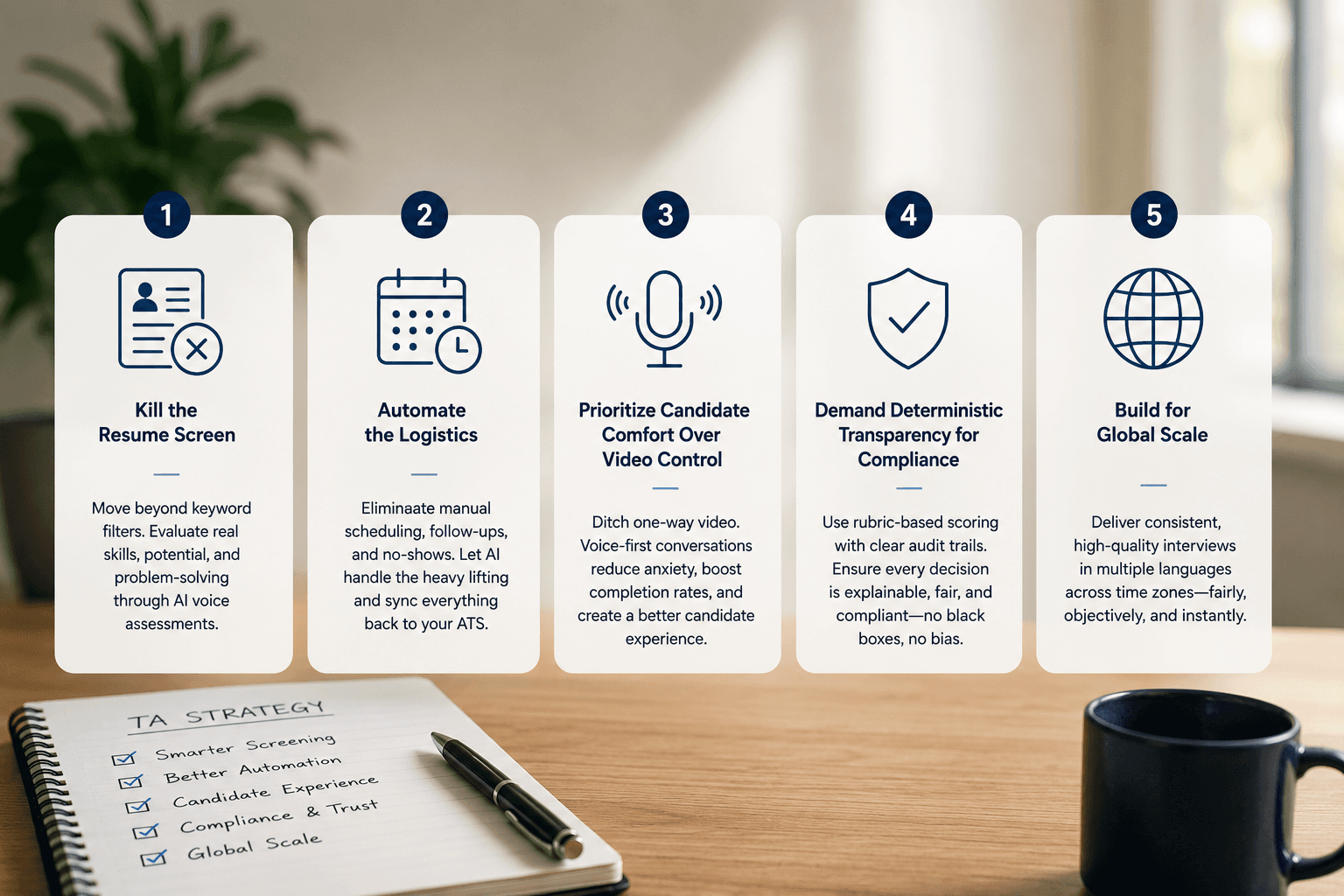
The talent acquisition landscape has fundamentally shifted. The traditional pipeline — relying heavily on human sourcers, manual phone screens, and subjective visual interviews — is buckling under the weight of high applicant volume and strict budget constraints. Organizations that refuse to modernize their top-of-funnel infrastructure are watching their cost-per-hire soar while losing top talent to faster, automated competitors.
Here are five imperatives HR leaders must act on now.
1. Kill the Resume Screen
Using ATS keyword parsing to evaluate candidates is functionally obsolete. It discards neurodivergent, non-traditional, and career-changing talent who simply lack the specific industry vocabulary. Transition to pure skills-based assessment. By deploying AI video screening, you can eliminate the manual resume review entirely — invite everyone to a 10-minute dynamic video interview and let the AI evaluate raw capability, problem-solving skills, and communication.
2. Automate the Logistics
Recruiters should not be administrative assistants. Time spent playing phone tag, managing calendar links, and dealing with no-shows is burning massive operational capital. When AI is properly integrated with your ATS, a candidate applies, the AI instantly engages them, conducts the interview, and automatically pushes the scorecard back into the native workflow — all without a human touching the process.
3. Replace One-Way Recording with Live AI Video
The era of the one-way recorded video interview is over. Candidates have universally rejected platforms that force them to perform for a camera with no one on the other side. Live AI video solves this — candidates engage in a real conversation with an AI that listens, responds, and adapts. Completion rates improve dramatically, candidate satisfaction improves, and hiring managers get video recordings alongside structured scorecards. That's a better outcome at every level.
4. Demand Deterministic Transparency for Compliance
With regulatory scrutiny on automated employment decision tools increasing rapidly, enterprise legal teams cannot accept black-box algorithms. Demand platforms with rubric-based grading — where every rejection can be traced back to a specific, clearly documented competency gap in the candidate's transcript. Avoid any platform that factors in visual biometric data or unscientific personality trait analysis.
5. Build for Global Scale
If your enterprise operates across geographies, your screening must be standardized but natively multilingual. Human recruiting teams struggle to maintain consistent assessment quality across languages and time zones. A centralized AI platform can conduct rigorous interviews in dozens of languages, ensuring a candidate in Berlin is evaluated exactly like a candidate in Toronto — fairly, objectively, and instantly.
Braintrust AIR was built to meet all five of these requirements. For a strategic consultation on rebuilding your TA tech stack this year, book a demo with our enterprise solutions team.