
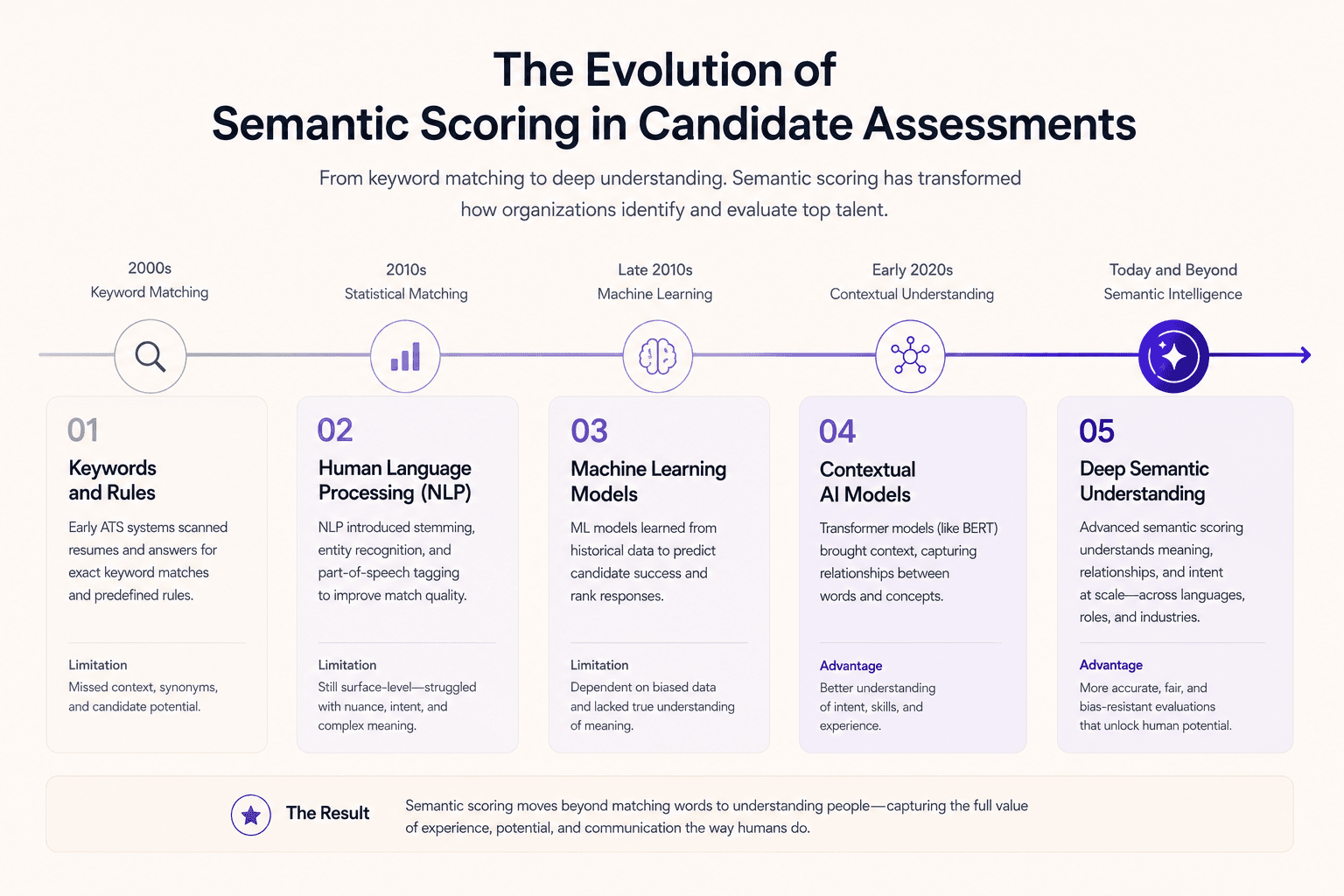
The history of recruiting technology is largely a history of keyword matching. For two decades, Applicant Tracking Systems triaged incoming resumes by scanning for precise text matches. If a job description required a "Project Manager," and a stellar candidate's resume said "Head of Operations," the system rejected them. This primitive parsing created a cottage industry of resume optimization, fundamentally breaking the signal-to-noise ratio in hiring.
Semantic scoring is the replacement. Instead of checking whether a candidate used the exact words in the job description, a semantic scoring engine evaluates what the candidate actually said and how well the meaning of that answer matches the requirement. The shift matters because keyword filtering was never measuring skill. It was measuring vocabulary.
The short answer
- What it is. Semantic scoring evaluates the meaning of a candidate's answer against a role rubric, rather than matching literal strings from a resume.
- How it works. Capture the response, transcribe it, embed and interpret it with a language model, score each rubric criterion, and hand a human an evidence-linked scorecard.
- How accurate it is. More accurate than the keyword filter it replaces, and bounded by two measurable error sources: transcription error and rubric design. Structured evaluation is the strongest single lever, at an operational validity of .42 against .19 for unstructured interviews.
- What it does not do. It does not make the hiring decision, and it does not remove your obligation to audit for adverse impact.
What semantic scoring is
Semantic scoring is a method of evaluating candidate responses on meaning and intent rather than on exact keyword overlap. A keyword system asks whether the string "project management" appears. A semantic system asks whether the candidate described planning work, sequencing dependencies, and managing stakeholders, in whatever words they chose.
The difference is not cosmetic. Research on hiring filters found that 88 percent of employers with high-skills roles and 94 percent with middle-skills roles said qualified candidates are vetted out by their systems for not matching exact criteria, according to the Harvard Business School and Accenture Hidden Workers study. The same research put the population of United States hidden workers at more than 27 million people.
Those are not fringe cases. They are the cost of asking a text matcher to do a judgment task.
How AI candidate screening works, step by step
AI candidate screening works in five stages, and only the middle three involve a model at all.
Scroll to see all columns
| Stage | What happens | Where errors enter |
|---|---|---|
| 1. Rubric design | A recruiter defines the competencies for the role and the anchors that separate a strong answer from a weak one | Vague or proxy criteria, encoded before any model runs |
| 2. Capture | The candidate answers in their own words, by voice, video, or text | Audio quality, network conditions, candidate device |
| 3. Transcription | Speech is converted to text by an automatic speech recognition model | Word error rate, which varies by speaker group and accent |
| 4. Interpretation and scoring | A language model maps the response to each rubric criterion and assigns a score with a rationale | Model bias, rubric drift, ungrounded scores |
| 5. Human review | A recruiter reads the scorecard, the rationale, and the recording, then decides | Automation bias, if the reviewer rubber-stamps the score |
Scroll to see all columns
Note where the model sits. It occupies stages three and four. Stage one is human judgment written down in advance, and stage five is human judgment applied at the end. A screening system that removes either of those is not a better model. It is a worse process.
"Human recruiters, even well-trained ones, make rapid judgments based on non-verbal cues, vocal tone, cultural familiarity, and demographic signals," writes Grady Gardner, GM and CRO at Braintrust, in an analysis of AI and human screening performance.
Semantic scoring compared with keyword matching
Scroll to see all columns
| Dimension | Keyword matching | Semantic scoring |
|---|---|---|
| Unit of analysis | Literal string in a document | Meaning of a response against a rubric criterion |
| Input | The resume the candidate wrote for the algorithm | The answer the candidate gives in their own words |
| Synonym handling | Fails unless a synonym list is maintained by hand | Handled by the model, without a curated list |
| Career changers | Systematically rejected for wrong vocabulary | Evaluated on transferable evidence |
| Gaming | Rewarded by keyword stuffing | Harder to game with vocabulary alone, still gameable with rehearsed answers |
| Explainability | Trivially explainable, and rarely job related | Explainable only if the vendor exposes per-criterion rationale |
| Audit exposure | Rarely audited, still subject to adverse impact law | Explicitly in scope for bias audit rules in several jurisdictions |
Scroll to see all columns
The last row is the one buyers skip. Moving from keyword matching to semantic scoring does not reduce legal exposure. It documents it.
How accurate is AI candidate screening
AI candidate screening is more accurate than keyword filtering at the task it replaces, and less accurate than its marketing implies. Both halves of that sentence are supported, and the honest version of this answer names the error sources rather than quoting a single accuracy percentage.
Structure is the strongest lever
In the largest recent re-analysis of selection method validity, structured interviews showed an operational validity of .42 against .19 for unstructured interviews, with job knowledge tests at .40 and general mental ability at .31. Structure, not the presence of a model, is what predicts performance. A well-built AI interview is valuable because it makes structure cheap enough to apply to every candidate.
Transcription error is real and unevenly distributed
Any voice-based screen inherits the error rate of its speech recognition layer, and that error rate is not evenly distributed. A 2020 study of five commercial systems measured an average word error rate of 0.35 for Black speakers against 0.19 for white speakers. Ask any vendor for its current word error rates by speaker group, in writing. The accessibility obligations that follow from this are covered in our guide to how an AI interviewer works.
Model bias does not disappear because the model is bigger
A University of Washington audit of embedding-based resume retrieval, across more than 500 resumes and 500 job descriptions, found the system favored white-associated names over Black-associated names in 85.1 percent of cases, and favored female-associated names over male-associated names in only 11.1 percent (Wilson and Caliskan, AIES 2024). Separately, a field experiment covering 83,000 applications measured a 2.1 percentage point lower callback rate for distinctively Black names, with a small number of firms driving roughly half of the gap. Human and machine screening both need measurement, not assurances.
Semantic retrieval is not automatically better on every task
The BEIR benchmark evaluated ten retrieval systems across eighteen datasets and found that keyword-based BM25 remains a strong baseline, and dense retrieval models often underperform other approaches in zero-shot settings. Applied to hiring, the lesson is narrow and useful. Semantic scoring wins when it is tuned to the role and the rubric, not by default.
Where semantic scoring still gets it wrong
- Rehearsed answers. A candidate coached on the competency model can produce a well-formed narrative without the underlying experience. Adaptive follow-up questions are the counter, since they probe specifics the script does not cover.
- Rubric quality. A model scoring a bad rubric produces confident, consistent, job-irrelevant scores. The rubric is the product.
- Confidence without calibration. A score with no rationale and no confidence signal cannot be reviewed, only obeyed.
- Automation bias. If reviewers approve every ranked list without opening a transcript, the human review stage exists on the org chart and not in practice.
- Speech and language variation. Accents, speech differences, and non-native fluency all interact with the transcription layer, which is why accommodation paths need to be built in rather than requested.
What the rules already require
This is the section most articles on semantic scoring omit entirely, and it is the one that decides whether a deployment survives contact with counsel.
Scroll to see all columns
| Rule | Scope | Core obligation |
|---|---|---|
| NYC Local Law 144 | Automated employment decision tools used for NYC roles | Independent bias audit within the prior year, published results, and 10 business days' notice to candidates |
| EU AI Act, Annex III 4(a) | AI used to filter applications and evaluate candidates | Classified high risk, with conformity, documentation, and human oversight duties |
| Uniform Guidelines, 29 CFR 1607.4(D) | All US selection procedures | Adverse impact where a group's selection rate falls below 80 percent of the highest group's rate |
Scroll to see all columns
Compliance in practice lags the rule. A study of 391 employers covered by Local Law 144 found that only 18 had published a bias audit and 13 had posted a transparency notice. Buyers who ask for the audit are asking for something most of the market has not produced.
How to evaluate a semantic scoring vendor
Scroll to see all columns
| Ask for | A good answer looks like | A weak answer looks like |
|---|---|---|
| Per-criterion rationale | Each score links to the specific response text that produced it | A single composite score with no trace |
| Bias audit | An independent audit report you can read, with impact ratios by group | "Our model is bias free" |
| Transcription performance | Word error rate reported across accents and speaker groups | The vendor has never measured it |
| Human decision rights | The system cannot reject a candidate on its own | Auto-rejection below a score threshold |
| Data use | Customer candidate data is excluded from model training | Silence, or an opt-out buried in the DPA |
| Accommodation | A documented alternative path for candidates who need one | Handled case by case on request |
Scroll to see all columns
Braintrust publishes an independent third-party bias audit and a jurisdiction-by-jurisdiction compliance map. Ask every vendor for the same two artifacts, and ask each of them, Braintrust included, for the impact ratios by group that sit behind the headline result.
What this changes for non-traditional candidates
Semantic scoring is the reason a candidate moving from the military, hospitality, or field operations into a corporate role can be evaluated at all. Those candidates rarely use the vocabulary of the job description. They describe the same competencies in the language of their own industry.
Consider two answers to a question about resilience after a project failure. One candidate says they used project management skills to pivot deliverables and hit their KPIs despite an initial blocker. The other says that when half the team got sick before launch, they reorganized the remaining sprint tickets, told stakeholders about the delay directly, and shipped a smaller stable version a week later.
A keyword system scores the first answer higher, because it contains the words. A semantic system scores the second higher, because it contains the evidence. That single reversal is the entire argument for skills-based hiring over resume screening, and it is why adaptive interviewing matters more than any single scoring model.
To see how Braintrust AIR scores an unscripted answer, run a live interview yourself or book a demo and test it with a career changer's profile.
Frequently Asked Questions
What is semantic scoring in candidate assessment
Semantic scoring is the evaluation of a candidate's answer on meaning and intent against a role rubric, rather than on literal keyword overlap with a job description. It reads what a candidate demonstrated, not which words they chose.
How does AI resume screening work
AI resume screening parses the document, represents its content as meaning rather than strings, compares that representation against the requirements of the role, and returns a ranked list with rationale. Modern systems pair it with an interview, because a resume records claims and an interview produces evidence.
Just how accurate is AI screening in practice
Accuracy depends on structure, transcription quality, and rubric design rather than on the model alone. Structured evaluation carries an operational validity of .42 against .19 for unstructured interviews, and speech recognition error rates differ measurably across speaker groups, so both numbers belong in any vendor evaluation.
Is AI resume screening biased
AI resume screening can be biased, and so can the manual process it replaces. Audits of embedding-based screening have found large disparities by name, and field experiments have measured callback gaps in human screening. The difference is that automated tools can be measured continuously and are increasingly required to be.
Can AI reject my application without a human seeing it
That depends entirely on the employer's configuration. Braintrust AIR is built so that it cannot auto-reject, and a recruiter reviews the scorecard and recording before any decision. Candidates in New York City and Illinois also have notice rights covering automated evaluation.
What is the difference between semantic search and keyword matching
Keyword matching retrieves records containing a literal string. Semantic search retrieves records whose meaning is close to the query, so "Head of Operations" can match a project management requirement. Benchmark research shows semantic retrieval is not automatically superior, which is why tuning to the role matters.
Does semantic scoring help candidates from non-traditional backgrounds
Yes, when the rubric is written around competencies rather than pedigree. A career changer who describes the right behavior in the wrong vocabulary passes a semantic screen and fails a keyword filter.
What should we ask a vendor about screening accuracy
Ask for the independent bias audit with impact ratios by group, word error rates across accents, per-criterion score rationale, and written confirmation that the system cannot reject a candidate without human review.