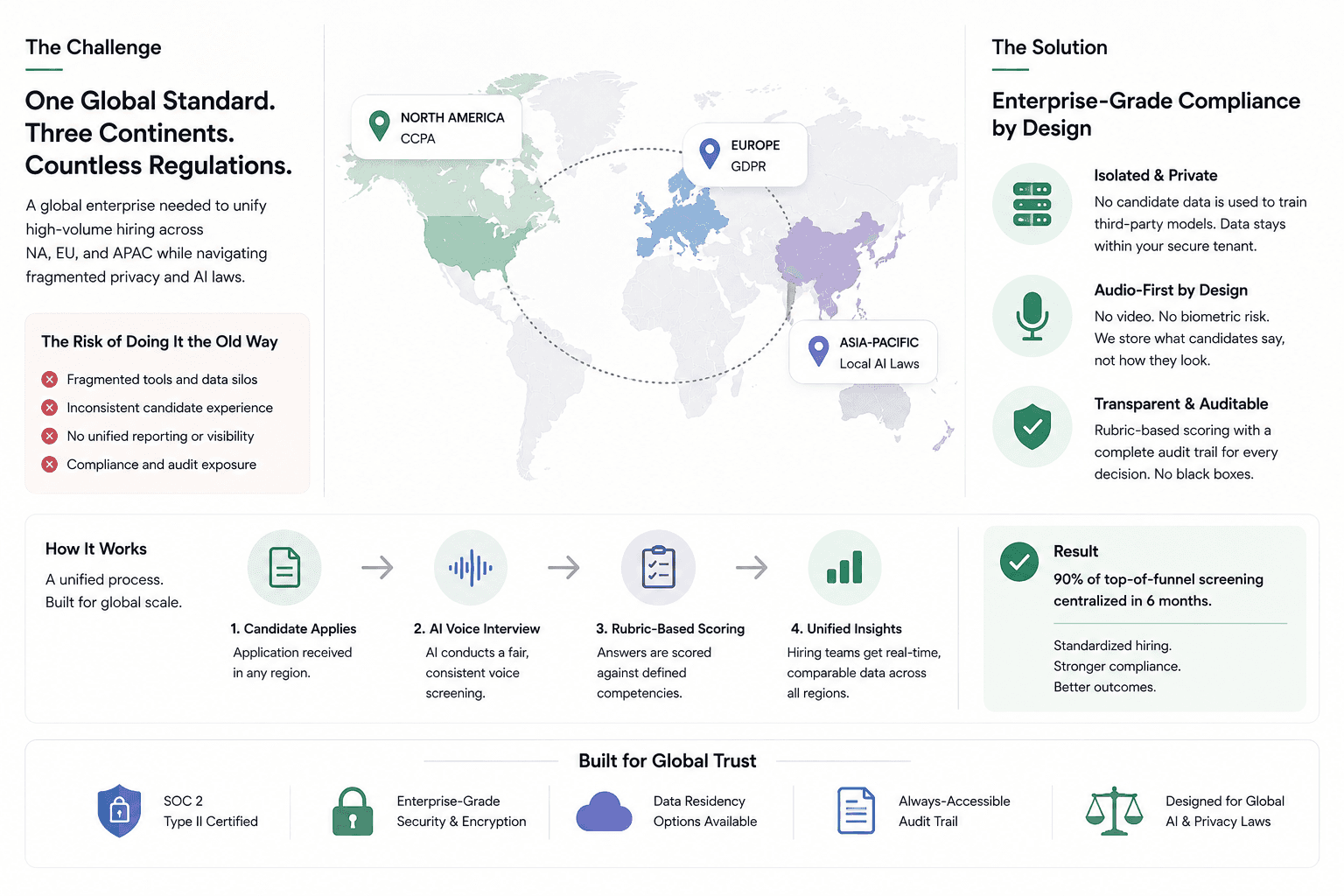
When a Global 2000 manufacturing and logistics company sought to standardize their hiring processes across North America, the European Union, and Asia-Pacific, they faced a complex wall of fragmented compliance requirements.
They desperately wanted to implement AI voice screening to manage the volume of seasonal warehouse and logistics applications. But their global legal team pumped the brakes. Managing candidate data across GDPR, CCPA, and local AI bias laws like NYC Local Law 144 seemed impossible to navigate from a centralized platform.
Historically, organizations handled this by fragmenting their tech stack — buying localized, bare-minimum tools for different regions. This created data silos and broke any concept of unified HR reporting. Moving to a single AI screening platform required architecture specifically designed for enterprise-grade compliance across jurisdictions.
Their solution was Braintrust AIR, chosen precisely because of its foundational security and compliance model.
The first issue was data residency and LLM training. Many generic AI tools send user data back to core providers to retrain public models — a catastrophic GDPR violation. AIR operates with completely isolated data partitioning. No candidate data, transcripts, or PII is ever used to feed or train third-party foundation models. Candidate data stays strictly within the enterprise's tenant, secured by SOC 2 Type II controls.
The second issue was data minimization. AIR's structured, rubric-based evaluation focuses assessment on what the candidate says — their competency demonstrations — rather than collecting unnecessary personal data. Where jurisdiction-specific requirements apply, configurable consent flows ensure candidates are fully informed before any data is processed. SOC 2 Type II controls govern all data storage and transmission.
Third, municipal bias laws require absolute transparency around algorithmic decisions. When an AI tool rejects a candidate, the team needs to instantly produce an audit trail showing why — with no opaque black-box logic. Because AIR uses a specific grading rubric — scoring transcripts against strictly defined behavioral and technical competencies — the platform provides a complete, always-accessible audit trail.
If a European works council questioned the rejection of a local candidate, the hiring manager could pull the scorecard immediately, showing clearly that the candidate failed to articulate the required safety protocol during the mock scenario. The rejection was 100% based on demonstrable skill.
Within six months, the conglomerate centralized 90% of their top-of-funnel screening onto the AI platform — globally, fully compliant, with standardized core competencies across all regions. To understand how AIR approaches regulatory exposure, book a demo to engage directly with our infrastructure specialists.