
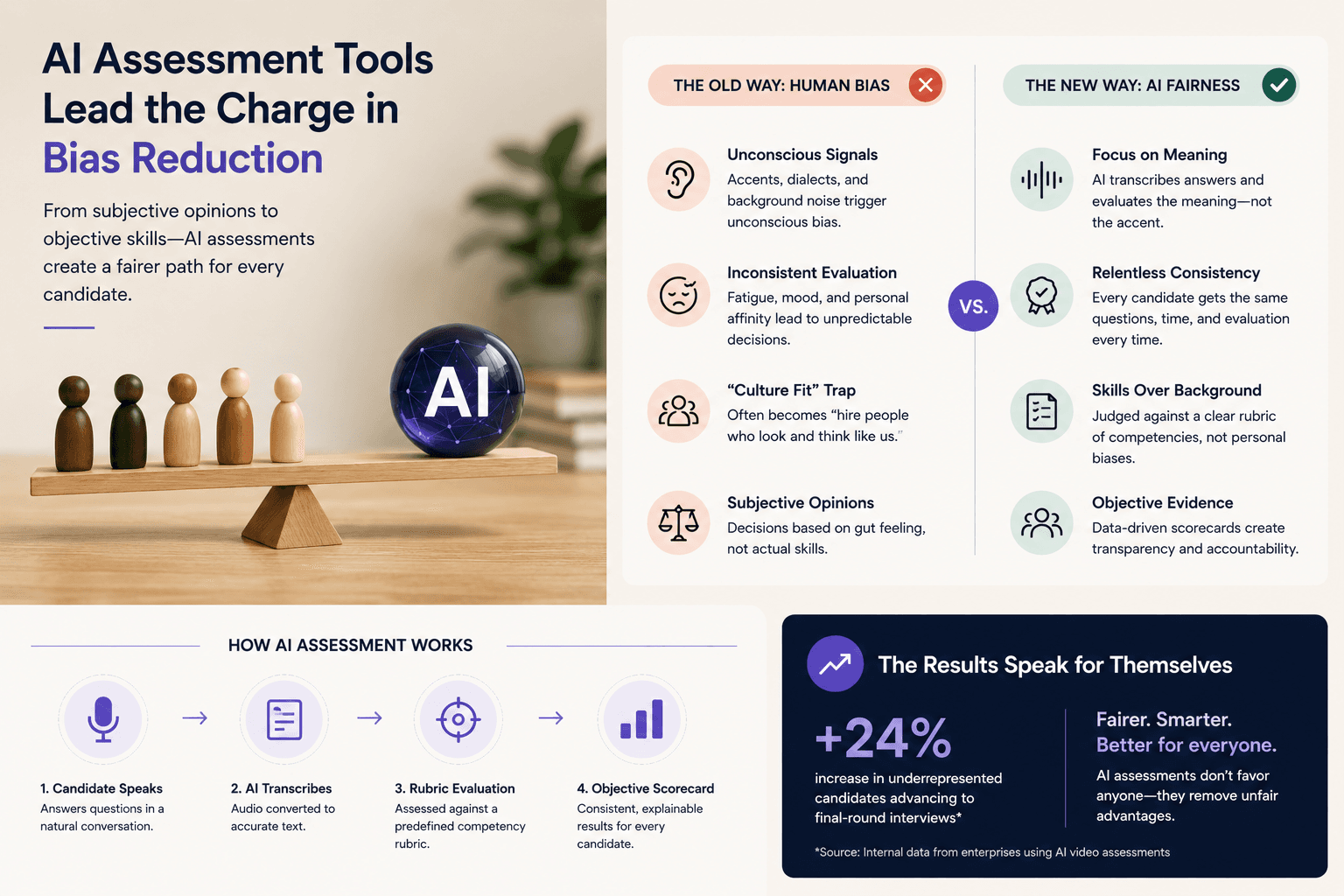
Diversity and fairness in hiring remain some of the most complex challenges for modern enterprise recruiting teams. For decades, companies have relied on human interviews specifically designed to assess "culture fit" alongside technical capabilities. Unfortunately, "culture fit" historically became a euphemism for hiring individuals who looked, thought, and spoke like the existing team — inherently disadvantaging candidates from diverse backgrounds.
The introduction of AI assessment tools represents a significant shift away from subjective evaluation toward objective skills measurement. While critics frequently voice concerns that AI might inherit human biases, properly designed conversational AI tools are explicitly architected to do the opposite.
Unlike early AI models that tried to evaluate candidates by cross-referencing successful past hires — a methodology riddled with systemic historical biases — modern platforms like Braintrust AIR use deterministic, competency-based rubrics rather than pattern-matching to historical outcomes.
Here's how that works in practice. When a human recruiter conducts a phone screen, they're immediately hit with an array of socioeconomic and demographic signals. They hear accents, dialects, background noise. Research consistently shows that recruiters unconsciously penalize candidates based on acoustic markers before the candidate even answers the first question.
An AI assessment tool ignores all of that. It takes the audio stream, transcribes it into text, and evaluates the semantic meaning of the transcript against a predefined rubric. The AI can't hear an accent — it only "sees" the concepts the candidate is communicating.
Moreover, the AI is relentlessly consistent. A human interviewer might be tired after their fifth interview of the day, rushing through questions or unconsciously forgiving a candidate they bonded with over a shared alma mater. The AI exhibits no fatigue, no affinity bias, no erratic behavior. Every candidate gets the same baseline questions. Every candidate gets equal time to articulate their experience.
This standardization creates a powerful, fair top-of-funnel filter. If a hiring manager wants to reject a candidate who scored 90/100 on the AI's technical competency assessment, they need to explain why — because the data doesn't support it.
When you run blind tests of this technology, the results are striking. Organizations consistently find that when they deploy structured, rubric-based AI video screening, the percentage of underrepresented candidates advancing to final-round interviews increases meaningfully. Not because the AI favors them — but because it stops filtering them out unfairly.
Replacing the inherently biased human phone screen with an objective, standardized conversational assessment is one of the fastest ways to drive tangible DEI outcomes. Book a demo to see how AIR enforces strict rubric-based fairness for every candidate, and what that looks like in practice.